Viewing note: This article contains several detailed tables and is best viewed on a desktop or tablet.
Collectors of Imperial German naval flags frequently encounter size markings such as “Gösch 0,7 × 1,0”, “2” or “3”. These markings were not simply arbitrary manufacturing sizes. An official Imperial German Navy regulation from 1892 shows that naval flags were produced in different size classes according to the type and size of vessel on which they were intended to be used.
The regulation, dated 31 May 1892, was published by the Reichs-Marine-Amt as a “Zusammenstellung über Benennung und Abmessung der Flaggen etc.” — a table listing the names and dimensions of flags, pennants, command flags and related naval signals.
It replaced the earlier flag classification of 26 May 1877 and was signed by Friedrich von Hollmann, State Secretary of the Imperial Naval Office.
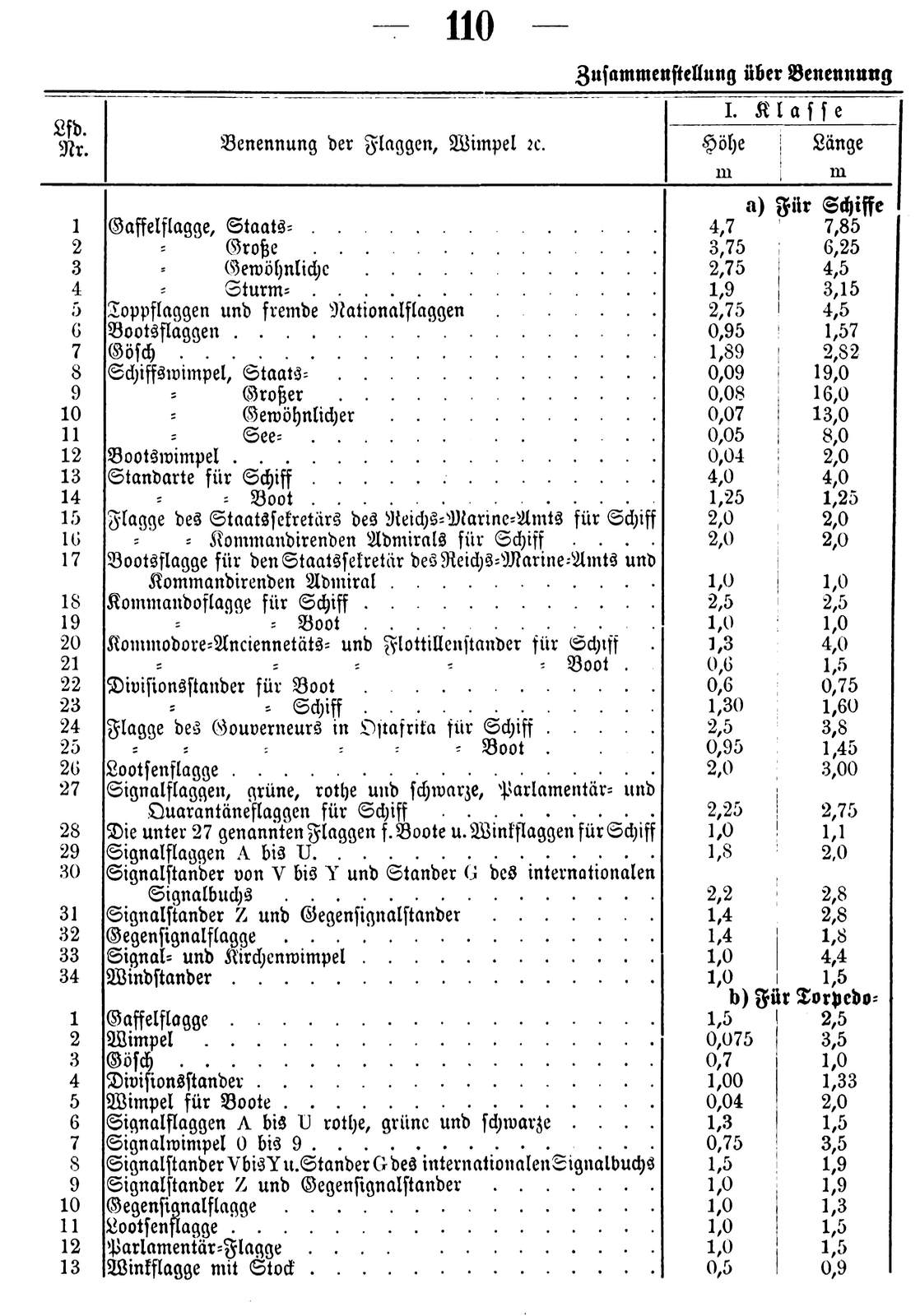
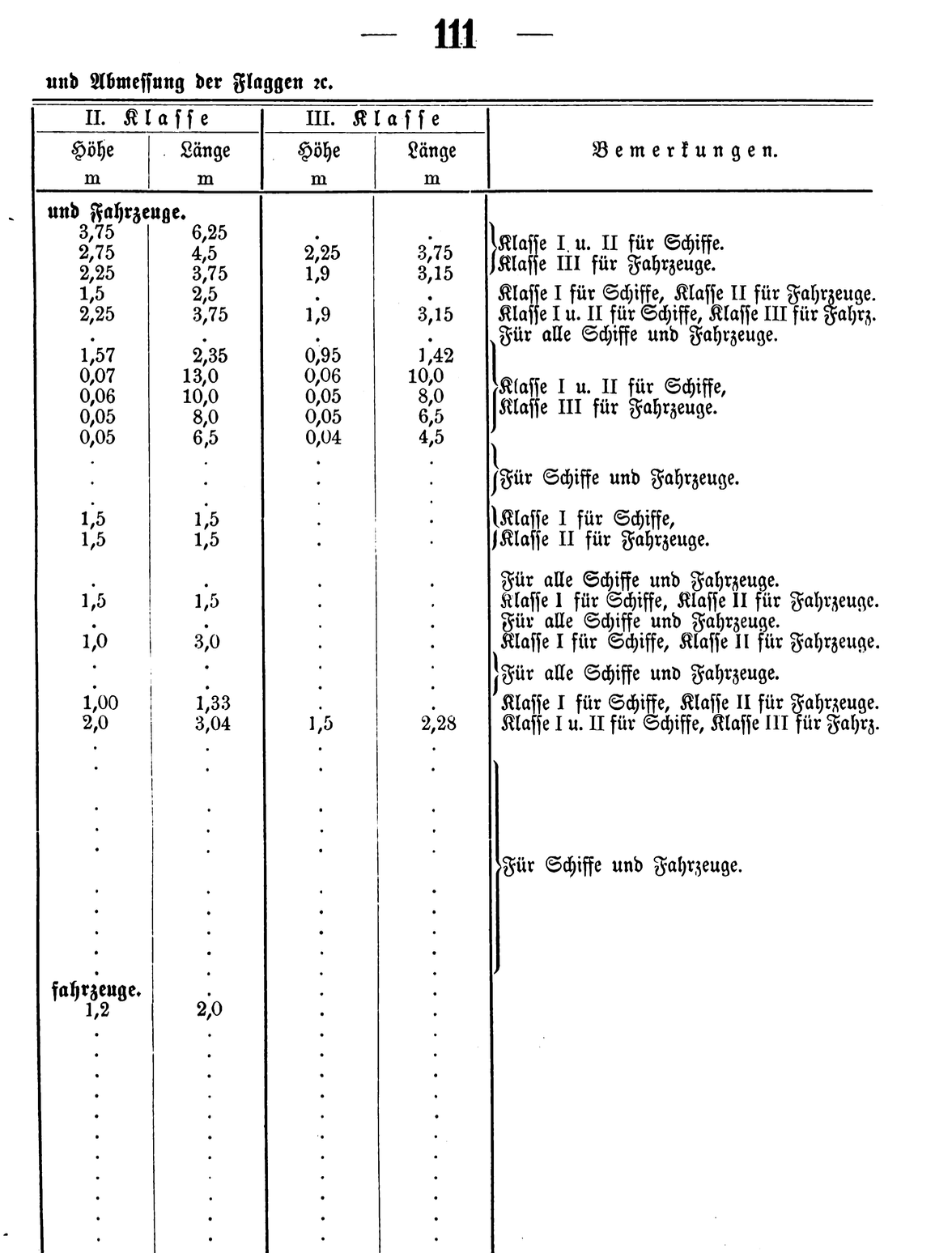
The original pages are reproduced above so the dimensions and application remarks can be checked directly against the source.
How the three sources fit together
Three contemporary or near-contemporary sources can be combined to understand what the 1892 size numbers actually meant in practice.
First, the 1892 Marineverordnungsblatt gives the official flag system. It provides the exact dimensions and states whether a given size was intended for Schiffe, Fahrzeuge, or, in a separate section, Torpedofahrzeuge. It does not, however, give tonnage limits for the individual size numbers.
Second, Franz Reinecke's 1900 Deutsches Flaggenhandbuch explains the principle behind the system. Reinecke states that the size of a flag must stand in a certain relationship to the size of the ship on which it is flown. He also explains that, for small ships, the smallest size number is generally the most suitable. Most importantly, he gives a practical example: an ordinary gaff ensign No. I on a large ship could be the same physical size as a large gaff ensign No. II on a smaller ship.
Third, the 1917 Handbuch der deutschen Marine provides the missing physical context. Its historical sections list former Imperial German warships together with their vessel types and actual displacement. This allows us to see the enormous range of ship sizes that lay behind the broad terms Schiff and Fahrzeug.
For example, the 1917 handbook lists SMS Großer Kurfürst at 6,770 tons, SMS Prinz Adalbert at 3,980 tons, SMS Bismarck at 2,860 tons and SMS Freya at 2,017 tons. At the smaller end it lists SMS Adler at 884 tons, SMS Eber at 576 tons, SMS Iltis at 489 tons and SMS Cyklop at 412 tons.
The handbook also gives concrete torpedo-craft examples. The old torpedo boat T 13 displaced only 80 tons, while the older division boat D 1 displaced 300 tons. Elsewhere the handbook describes the older small torpedo boats generally as vessels of about 100 tons displacement.
How this is used below: The 1917 ship examples are used only to illustrate the physical scale of Imperial German ships and craft. They are not presented as documented assignments of a particular ship to flag Size I, II or III. The official application comes from the 1892 regulation; the size principle comes from Reinecke; the ship examples and displacement figures come from the 1917 handbook.The 1892 system
The most important detail in the 1892 table is the remarks column. It does not merely list different manufacturing sizes. It explicitly distinguishes between Schiffe — ships — and Fahrzeuge — naval craft.
For several flag types, including the naval jack, the regulation states:
Klasse I u. II für Schiffe. Klasse III für Fahrzeuge.
In English:
Classes I and II for ships. Class III for craft.
Torpedo craft were treated separately. The lower part of the table contains an independent section headed “für Torpedofahrzeuge”, with its own gaff ensign, pennant, naval jack, division pennant and signal flags.
The Imperial German naval jack — Gösch
For collectors, one of the most useful entries is the Gösch, the naval jack flown at the bow of Imperial German warships.
The ordinary series contained three officially listed sizes:
| 1892 size | Official dimensions H × L | Official application | Interpretation |
|---|---|---|---|
| Class I | 1.89 × 2.82 m | ShipsIllustrative larger-ship examples from the 1917 handbook: SMS Großer Kurfürst — 6,770 t SMS Prinz Adalbert — 3,980 tSize context only. The handbook does not state that these individual ships were assigned Gösch Class I. | Larger of the two Gösch sizes prescribed for ships |
| Class II | 1.57 × 2.35 m | ShipsIllustrative smaller-ship examples from the 1917 handbook: SMS Bismarck — 2,860 t SMS Freya — 2,017 tSize context only. This is SMS Bismarck, the Imperial Kreuzerkorvette launched in 1874, not the later battleship. | Smaller of the two Gösch sizes prescribed for ships |
| Class III | 0.95 × 1.42 m | CraftIllustrative small-vessel examples from the 1917 handbook: SMS Adler — 884 t SMS Eber — 576 t SMS Iltis — 489 t SMS Cyklop — 412 tThese show the physical scale of smaller Imperial naval vessels; they are not documented Gösch Class III assignments. | Specifically prescribed for naval craft rather than ships |
| Torpedo-craft size | 0.70 × 1.00 m | TorpedofahrzeugeExamples from the 1917 handbook: T 13 — 80 t D 1 — 300 t Older small torpedo boats — about 100 tThe 0.70 × 1.00 m Gösch is explicitly listed under the separate 1892 Torpedofahrzeuge section. | Special Gösch specifically prescribed for torpedo craft |
The 0.70 × 1.00 metre Gösch
The 0.70 × 1.00 metre Gösch deserves special attention.
It was not simply listed as a fourth size beneath Classes I, II and III. Instead, it appears in a completely separate section of the regulation headed “für Torpedofahrzeuge”.
This means that a surviving jack marked:
GÖSCH – 0,7 × 1,0 m
can be associated specifically with the flag outfit prescribed for Imperial German torpedo craft.
The 1917 handbook helps show what that category meant physically. It lists the old torpedo boat T 13 at only 80 tons displacement and the older division boat D 1 at 300 tons. It also describes older small torpedo boats generally as approximately 100-ton vessels.
Collector's identification:A Gösch measuring approximately 0.70 × 1.00 metres is not merely a generic small Imperial German naval jack. Its dimensions correspond directly to the Gösch size listed in the official 1892 flag table under Torpedofahrzeuge.
Complete 1892 flag-size table
The following table translates the complete 1892 list. Hover over, or tap, Ships, Craft or Torpedofahrzeuge to see illustrative vessel examples from the 1917 handbook.
The examples provide scale only. They are not claimed as documented individual assignments to a particular flag size.
| No. | Original designation | English | Class | Dimensions H × L | Official application |
|---|---|---|---|---|---|
| 1 | Gaffelflagge, Staats- | State gaff ensign | I | 4.70 × 7.85 m | ShipsLarger-ship examples: SMS Großer Kurfürst — 6,770 t SMS Prinz Adalbert — 3,980 tIllustrative size context, not documented flag assignment. |
| II | 3.75 × 6.25 m | ShipsSmaller-ship examples: SMS Bismarck — 2,860 t SMS Freya — 2,017 tIllustrative size context, not documented flag assignment. | |||
| III | 2.75 × 4.50 m | CraftSmall-vessel examples: SMS Adler — 884 t SMS Eber — 576 t SMS Iltis — 489 t SMS Cyklop — 412 tIllustrative size context, not documented flag assignment. | |||
| 2 | Gaffelflagge, Große | Large gaff ensign | I | 3.75 × 6.25 m | ShipsLarger-ship examples: SMS Großer Kurfürst — 6,770 t SMS Prinz Adalbert — 3,980 tIllustrative size context only. |
| II | 2.75 × 4.50 m | CraftSmall-vessel examples: SMS Adler — 884 t SMS Eber — 576 t SMS Iltis — 489 t SMS Cyklop — 412 tIllustrative size context only. | |||
| 3 | Gaffelflagge, Gewöhnliche | Ordinary gaff ensign | I | 2.75 × 4.50 m | ShipsLarger-ship examples: SMS Großer Kurfürst — 6,770 t SMS Prinz Adalbert — 3,980 tIllustrative size context only. |
| II | 2.25 × 3.75 m | ShipsSmaller-ship examples: SMS Bismarck — 2,860 t SMS Freya — 2,017 tIllustrative size context only. | |||
| III | 1.90 × 3.15 m | CraftSmall-vessel examples: SMS Adler — 884 t SMS Eber — 576 t SMS Iltis — 489 t SMS Cyklop — 412 t | |||
| 4 | Gaffelflagge, Sturm- | Storm gaff ensign | I | 1.90 × 3.15 m | ShipsRepresentative ship examples are listed in the 1917 handbook.Reinecke specifically explains that storm flags were smaller because large flags were more quickly destroyed in heavy weather. |
| II | 1.50 × 2.50 m | CraftSmall-vessel examples: SMS Adler — 884 t SMS Eber — 576 t SMS Iltis — 489 t SMS Cyklop — 412 t | |||
| 5 | Toppflaggen und fremde Nationalflaggen | Masthead and foreign national flags | I | 2.75 × 4.50 m | ShipsLarger-ship examples: SMS Großer Kurfürst — 6,770 t SMS Prinz Adalbert — 3,980 t |
| II | 2.25 × 3.75 m | ShipsSmaller-ship examples: SMS Bismarck — 2,860 t SMS Freya — 2,017 t | |||
| III | 1.90 × 3.15 m | CraftSMS Adler — 884 t SMS Eber — 576 t SMS Iltis — 489 t SMS Cyklop — 412 t | |||
| 6 | Bootsflaggen | Boat flags | — | 0.95 × 1.57 m | Ships and craft |
| 7 | Gösch | Naval jack | I | 1.89 × 2.82 m | ShipsIllustrative larger-ship examples: SMS Großer Kurfürst — 6,770 t SMS Prinz Adalbert — 3,980 tScale context only; not documented individual Gösch assignments. |
| II | 1.57 × 2.35 m | ShipsIllustrative smaller-ship examples: SMS Bismarck — 2,860 t SMS Freya — 2,017 tScale context only; not documented individual Gösch assignments. | |||
| III | 0.95 × 1.42 m | CraftIllustrative small-vessel examples: SMS Adler — 884 t SMS Eber — 576 t SMS Iltis — 489 t SMS Cyklop — 412 tScale context only; not documented individual Gösch assignments. | |||
| 8 | Schiffswimpel, Staats- | State ship pennant | I | 0.09 × 19.0 m | Ships |
| II | 0.07 × 13.0 m | Ships | |||
| III | 0.06 × 10.0 m | Craft | |||
| 9 | Schiffswimpel, Großer | Large ship pennant | I | 0.08 × 16.0 m | Ships |
| II | 0.06 × 10.0 m | Ships | |||
| III | 0.05 × 8.0 m | Craft | |||
| 10 | Schiffswimpel, Gewöhnlicher | Ordinary ship pennant | I | 0.07 × 13.0 m | Ships |
| II | 0.05 × 8.0 m | Ships | |||
| III | 0.05 × 6.5 m | Craft | |||
| 11 | Schiffswimpel, See- | Sea pennant | I | 0.05 × 8.0 m | Ships |
| II | 0.05 × 6.5 m | Ships | |||
| III | 0.04 × 4.5 m | Craft | |||
| 12 | Bootswimpel | Boat pennant | — | 0.04 × 2.0 m | Ships and craft |
| 13 | Standarte für Schiff | Standard for ship | I | 4.0 × 4.0 m | Ships |
| II | 1.50 × 1.50 m | Craft | |||
| 14 | Standarte für Boot | Standard for boat | — | 1.25 × 1.25 m | Boat |
| 15 | Flagge des Staatssekretärs des Reichs-Marine-Amts für Schiff | Flag of the State Secretary of the Imperial Naval Office for ship | I | 2.0 × 2.0 m | Ships |
| II | 1.50 × 1.50 m | Craft | |||
| 16 | Flagge des Kommandierenden Admirals für Schiff | Flag of the Commanding Admiral for ship | I | 2.0 × 2.0 m | Ships |
| II | 1.50 × 1.50 m | Craft | |||
| 17 | Bootsflagge für Staatssekretär und Kommandierenden Admiral | Boat flag for State Secretary and Commanding Admiral | — | 1.0 × 1.0 m | Boat |
| 18 | Kommandoflagge für Schiff | Command flag for ship | — | 2.5 × 2.5 m | Ships and craft |
| 19 | Kommandoflagge für Boot | Command flag for boat | — | 1.0 × 1.0 m | Boat |
| 20 | Kommodore-, Anciennetäts- und Flottillenstander für Schiff | Commodore, seniority and flotilla pennant for ship | — | 1.30 × 4.0 m | Ships and craft |
| 21 | Kommodore-, Anciennetäts- und Flottillenstander für Boot | Commodore, seniority and flotilla pennant for boat | — | 0.60 × 1.50 m | Boat |
| 22 | Divisionsstander für Boot | Division pennant for boat | — | 0.60 × 0.75 m | Boat |
| 23 | Divisionsstander für Schiff | Division pennant for ship | I | 1.30 × 1.60 m | Ships |
| II | 1.00 × 1.33 m | Craft | |||
| 24 | Flagge des Gouverneurs in Ostafrika für Schiff | Flag of the Governor in East Africa for ship | I | 2.50 × 3.80 m | Ships |
| II | 2.00 × 3.04 m | Ships | |||
| III | 1.50 × 2.28 m | Craft | |||
| 25 | Flagge des Gouverneurs in Ostafrika für Boot | Flag of the Governor in East Africa for boat | — | 0.95 × 1.45 m | Boat |
| 26 | Lootsenflagge | Pilot flag | — | 2.0 × 3.0 m | Ships and craft |
| 27 | Signalflaggen, grüne, rothe und schwarze, Parlamentär- und Quarantäneflaggen für Schiff | Green, red and black signal flags, flag of truce and quarantine flags for ship | I | 2.25 × 2.75 m | Ships |
| 28 | Die unter 27 genannten Flaggen für Boote und Winkflaggen für Schiff | Flags listed under No. 27 for boats and hand signal flags for ships | — | 1.0 × 1.1 m | Boats / signalling |
| 29 | Signalflaggen A bis U | Signal flags A to U | — | 1.8 × 2.0 m | Ships and craft |
| 30 | Signalstander von V bis Y und Stander G des internationalen Signalbuchs | Signal pennants V to Y and pennant G of the International Code | — | 2.2 × 2.8 m | Ships and craft |
| 31 | Signalstander Z und Gegensignalstander | Signal pennant Z and answering pennant | — | 1.4 × 2.8 m | Ships and craft |
| 32 | Gegensignalflagge | Answering signal flag | — | 1.4 × 1.8 m | Ships and craft |
| 33 | Signal- und Kirchenwimpel | Signal and church pennant | — | 1.0 × 4.4 m | Ships and craft |
| 34 | Windstander | Wind pennant | — | 1.0 × 1.5 m | Ships and craft |
Special flag outfit for Torpedofahrzeuge
The 1892 table then begins a separate section specifically for torpedo craft. The dimensions below are the official values printed in that section.
| No. | Original designation | English | Dimensions H × L |
|---|---|---|---|
| 1 | Gaffelflagge | Gaff ensign | 1.50 × 2.50 m |
| 2 | Wimpel | Pennant | 0.075 × 3.50 m |
| 3 | Gösch | Naval jack | 0.70 × 1.00 mTorpedo-craft scale examples from the 1917 handbook: T 13 — 80 t D 1 — 300 t Older small torpedo boats — about 100 t |
| 4 | Divisionsstander | Division pennant | 1.00 × 1.33 m |
| 5 | Wimpel für Boote | Pennant for boats | 0.04 × 2.00 m |
| 6 | Signalflaggen A bis U, rothe, grüne und schwarze | Signal flags A to U, red, green and black | 1.30 × 1.50 m |
| 7 | Signalwimpel 0 bis 9 | Signal pennants 0 to 9 | 0.75 × 3.50 m |
| 8 | Signalstander V bis Y und Stander G des internationalen Signalbuchs | Signal pennants V to Y and G of the International Code | 1.50 × 1.90 m |
| 9 | Signalstander Z und Gegensignalstander | Signal pennant Z and answering pennant | 1.00 × 1.90 m |
| 10 | Gegensignalflagge | Answering signal flag | 1.00 × 1.30 m |
| 11 | Lootsenflagge | Pilot flag | 1.00 × 1.50 m |
| 12 | Parlamentär-Flagge | Flag of truce | 1.00 × 1.50 m |
| 13 | Winkflagge mit Stock | Hand signal flag with staff | 0.50 × 0.90 m |
What did Class I, II and III actually mean?
The Roman numerals in the 1892 table are size numbers for each particular type of flag, not universal ship classes.
Reinecke makes this especially clear. He states that a flag's size should stand in a certain proportion to the size of the ship on which it is flown, and that for small ships the smallest size number is generally the most suitable.
He also gives a particularly useful example: an ordinary gaff ensign No. I for a large ship was the same physical size as a large gaff ensign No. II for a smaller ship.
In other words, the numbering describes the scale of that particular flag type. This explains why the same physical dimensions recur under different size numbers for different flags.
The sources examined here do not provide a fixed formula such as “Size I above X tons” or “Size II between X and Y tons”. The vessel examples from the 1917 handbook therefore provide physical context, not official tonnage thresholds.What this means for collectors
A surviving Imperial German naval flag can sometimes be placed into a considerably narrower historical context from its original size marking alone.
| Gösch size | 1892 application | What can safely be concluded |
|---|---|---|
| 1.89 × 2.82 m | Class I — Schiff | Larger ship-size Gösch |
| 1.57 × 2.35 m | Class II — Schiff | Smaller ship-size Gösch |
| 0.95 × 1.42 m | Class III — Fahrzeug | Gösch specifically intended for naval craft |
| 0.70 × 1.00 m | Torpedofahrzeug | Special Gösch specifically listed for torpedo craft |
Sources
Marineverordnungsblatt, 1892.
Nr. 111, “Zusammenstellung über Benennung und Abmessung der Flaggen etc.”, Berlin, 31 May 1892, pp. 110–111. Issued by the Reichs-Marine-Amt and signed by State Secretary Friedrich von Hollmann.
Franz Reinecke, Deutsches Flaggenhandbuch.
Hannover and Leipzig, 1900, especially pp. 152–156. Reinecke explains that flag size should correspond to vessel size, that the smallest size number was generally most suitable for small ships, and reproduces the Imperial Navy's flag-size series.
Handbuch der deutschen Marine und der Seestreitkräfte des Auslandes.
Kiel, 1917. Used here for the type and displacement of Imperial German ships and former Imperial German warships, including SMS Großer Kurfürst, SMS Prinz Adalbert, SMS Bismarck, SMS Freya, SMS Adler, SMS Eber, SMS Iltis and SMS Cyklop, together with torpedo-craft examples such as T 13 and D 1.
Methodological note: Flag dimensions and the distinctions between Schiffe, Fahrzeuge and Torpedofahrzeuge come from the official 1892 regulation. Reinecke's 1900 handbook supplies the contemporary explanation that flag size was scaled to vessel size. The 1917 handbook supplies vessel types and displacement figures used as illustrative historical context. It does not document the individual flag-size assignment of the example ships.
Original FlagGeek publication · Source status: LIVE. Research text and evidence retained from the Blogger export.
FlagGeek · https://flaggeek-v2.pages.dev/resources/imperial-german-naval-flag-sizes/